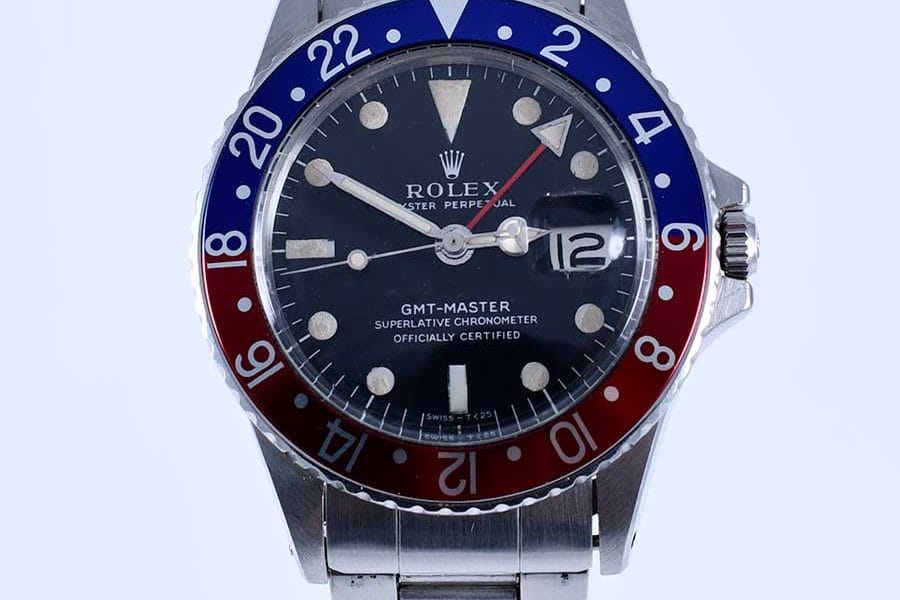
In April 2026, Rolex confirmed it was discontinuing the steel two-tone "Pepsi" GMT-Master II, reference 126710BLRO, at Watches & Wonders in Geneva. Within the first quarter, the secondary-market price on that exact reference jumped nearly 12%. Then it gave most of that gain back, as sellers who'd been sitting on one flooded the market and listings surged to record volumes. If you own one, watched one, or were thinking about buying one, that whipsaw is a more useful lesson than almost anything written about watches as investments this year — because it happened at the same moment the high end of the market was posting numbers nobody's ever seen before.
The Season That Broke the Scoreboard
Phillips' Geneva Watch Auction: XXIII, run in association with Bacs & Russo on May 9–10, 2026, closed at CHF 74,846,995 — roughly $96.3 million — making it the highest-grossing single watch auction in history. Forty-three individual lot records fell in that one sale. Sell-through hit 99.5%, meaning almost nothing offered failed to find a buyer, which in an auction environment signals a market where demand genuinely outpaces supply of the pieces collectors actually want, not just aggressive reserve pricing dressed up as strong results.
Christie's had its own record year, growing its luxury category 17% to $795 million. Its Important Watches sale in New York on December 8 brought in $42.8 million with a 100% "white glove" sell-through — auction-speak for every single lot selling — anchored by the Olmsted Complications Collection, which alone accounted for $22.4 million of that total. Separately, Christie's posted its best-ever various-owner watch result at $42.3 million, matching Phillips' pattern of records falling across multiple sale formats rather than one lucky night. Sotheby's overall luxury turnover, which combines watches, jewelry, and handbags rather than isolating timepieces, rose 22% to $2.7 billion for the year — worth noting as context for how the broader luxury category performed, even though it doesn't isolate watch-specific numbers the way Phillips' and Christie's figures do.
The Watch That Explains the Whole Season
One sale captures what's actually driving these numbers better than any aggregate figure. A 1943 stainless-steel Patek Philippe Reference 1518 sold for CHF 14,190,000 — a world record for a vintage Patek Philippe wristwatch, and earlier reporting on the same piece had estimated it closer to $17.6 million in dollar terms. Steel, not gold or platinum, is the material driving the record. That's not a coincidence, and it's not new information if you've paid attention to vintage Patek and Rolex sales over the past decade — steel sports and dress watches from the mid-20th century were made in tiny numbers relative to precious-metal versions, because steel wasn't the luxury flex it is today. Scarcity plus provenance plus a market that's become dramatically more sophisticated about both is what turns a 1940s steel watch into a $17 million lot.
What this actually means if you're not bidding at Phillips
None of this changes what you should pay for a watch at your local authorized dealer or a reputable pre-owned platform next month.
The eight-figure results are happening in a completely different tier of the market — rare, historically significant, extensively provenanced pieces being fought over by a small number of serious collectors and institutions. A record Geneva auction season tells you the top of the market is healthy and confident. It tells you almost nothing about whether you should pay a premium for a current-production steel sports watch, and conflating the two is exactly how people talk themselves into bad purchases.
Record Prices Attract Fakes — Buy Accordingly
A market posting the kind of numbers Phillips, Christie's, and Sotheby's put up this season doesn't just attract serious collectors. It attracts counterfeiters and gray-market operators betting that rising prices make buyers less careful, not more, because everyone's afraid of missing out on a market that's clearly moving. Don't let a record auction season talk you into skipping the basics you'd normally insist on for a five-figure purchase. Buy from an authorized dealer or a pre-owned platform that offers independent authentication and a real return window — not a private seller on a forum offering a suspiciously clean deal because they "need cash fast." Verify the serial number against the manufacturer where that's possible, and treat a watch with no box or papers as a negotiating point, not a dealbreaker, since plenty of legitimate watches lose their original packaging over decades of ownership. The single biggest red flag in a hot market isn't a missing box — it's a price meaningfully below what comparable pieces are trading for, offered by someone in a hurry to close. That combination has separated more buyers from their money than any counterfeit that actually looked convincing in photos.
The Actual Lesson Is the Pepsi GMT
The Pepsi GMT-Master II discontinuation is the more relevant data point for anyone reading this instead of bidding seven figures at Bacs & Russo. When Rolex kills a reference, the immediate market reaction is predictable: prices spike on the assumption that no more will ever be made, and speculative buyers pile in trying to catch the wave. What happened next with the 126710BLRO is also predictable, and it's the part people conveniently forget while they're chasing the initial spike — owners who'd been holding one for exactly this moment cashed out, listings flooded the secondary market, and most of that 12% gain evaporated within the same quarter. Buy a discontinued Rolex sport model in the first three months after the announcement and you're very likely buying at the top of a hype cycle that a huge percentage of current owners are simultaneously trying to sell into. Wait six to twelve months instead. Let the initial wave of opportunistic sellers clear the market, let the price find its actual level once the panic-selling and panic-buying both settle, and you'll generally get a fairer number — sometimes a meaningfully better one. This isn't a hard rule for every discontinued reference; a genuinely rare configuration with real production-number scarcity behind it can hold or keep climbing. But for a mainstream steel sports model that Rolex produced in significant volume for years, the discontinuation pop and correction pattern has played out enough times now that betting against it takes a specific reason, not just optimism.
If you're set on a steel Pepsi GMT specifically, the better move right now is patience over urgency — the correction phase this reference is currently in in is closer to a buying window than a reason to panic-purchase before prices "run away." And if what you actually want is exposure to the part of the watch market that's genuinely breaking records, that's the vintage steel tier the Patek 1518 sale just re-priced upward — a different, much more expensive game than chasing a discontinued current-production GMT, and one where provenance and paperwork matter as much as the watch itself.
The season's headline number is $96.3 million for one auction. The number that should actually change your buying decision this year is 12%, followed by a correction, on a watch you can walk into an authorized dealer and see in person. Keep those two stories separate and you'll make better decisions than most people currently reading Instagram posts about "the watch market going crazy" and assuming both stories are the same one.