A friend who owns four watches worth more than his first car once showed up to dinner wearing a rubber hair tie as a bracelet — not because he liked it, but because he had never once considered that the space around his watch was worth thinking about. He could quote the reference number of his Tudor Black Bay and the exact week he had been waitlisted for it, but the cufflinks holding his shirt cuffs together were a free pair that came in a gift box from a department store a decade earlier, stamped with a generic knot pattern and no maker's name anywhere on the back. That gap — obsessive knowledge about one object on the wrist, total indifference to everything else worn alongside it — is closing fast among the same buyers who pushed independent watchmaking and hand-cut eyewear into serious collecting territory over the past two years. The instinct driving people toward FP Journe and Jacques Marie Mage has not disappeared; it has just found a new set of objects to land on, and this time it is cufflinks, signet rings, and the kind of chain bracelet that used to be reserved for rock stars and now shows up on finance guys at dinner. Fine jewelry for men was, for a long time, a category most collectors skipped entirely, treated as either too flashy or too far outside their lane. That is no longer true, and the reason has less to do with fashion than with the same appetite for objects that can be traced back to a specific maker, a specific material standard, and a price that reflects actual gold rather than a brand premium.
Why Jewelry Is Following the Same Path as Watches and Eyewear
The pattern mirrors what happened with independent watchmaking almost exactly. Buyers who had already spent five and six figures on movements started asking why the rest of what they wore did not meet the same bar, and the market answered with brands that treat gold jewelry the way a watchmaker treats a calibre — hand-finished in small batches, with the sourcing and the standard stated up front instead of buried in a warranty card nobody reads. Cartier's resurgence this year has not just been about the Tank and the Santos; the Love bracelet has become something close to a gateway piece for people who would never have bought fine jewelry five years ago but already own a Cartier watch and understand the brand's codes. Gold itself is part of the story too — spot price crossed $5,000 a troy ounce in early 2026, up more than 70% year over year, which means the material cost underneath every solid-gold piece has genuinely changed, not just the markup on top of it. That single fact is doing more to push buyers toward fewer, better pieces than any marketing campaign could.
The Mark That Actually Tells You Something
Here is the first real skill gap most watch collectors have when they move into jewelry: they do not know how to read a hallmark, and almost nobody selling to them explains it. In the UK, a legal hallmark on anything over one gram has to carry three compulsory elements — a sponsor's or maker's mark, a fineness mark showing the millesimal purity (375 for 9 carat, 585 for 14 carat, 750 for 18 carat, 999 for 24 carat), and an assay office mark from one of the four offices still doing this work: London's leopard's head, Birmingham's anchor, Sheffield's Yorkshire rose, and Edinburgh's castle. (I still check for the Birmingham anchor out of habit on anything bought secondhand, mostly because it is the easiest mark to fake badly and the easiest to spot once someone has.) The US system works differently, and frankly more loosely — karat stamping is not even mandatory, but the moment a seller does stamp a piece, federal law requires a registered trademark next to it, and anything marked simply "gold" with no karat number is required to be 24 karat throughout. A ring stamped 14K with no trademark anywhere near it is not automatically fake, but it is not accountable to anyone either, and that distinction is the one that matters.
Vermeil is the term that trips up the most buyers, and it is worth understanding before spending real money on it. By the FTC's own definition, vermeil has to be sterling silver coated in gold — not base metal, not brass — with a minimum thickness of two and a half microns, and the gold has to be at least 10 karat. That is a genuine standard, not a marketing word, and it puts real vermeil well above the flimsy gold-plated costume pieces sold at similar price points online. But it is still not solid gold, and the coating wears thinner with contact — a vermeil ring worn daily through cooking, gym sessions, and dishwashing will show brass or silver at the high-friction points within a year or two, while a solid 14 karat piece just develops a patina. Buy vermeil for something you plan to rotate. Buy solid gold for something you plan to wear every day without thinking about it.
Cartier's Love Bracelet: The Anchor Piece
If one piece is responsible for pulling watch collectors into fine jewelry over the past eighteen months, it is the Love bracelet. The classic 18 karat yellow gold model, 6.1mm wide, currently retails for $7,950 in the US, up from roughly $6,300 in 2022, a jump that tracks almost exactly with the gold price story above. The flexible Love Unlimited version runs $9,400, and diamond-paved versions start well north of $27,000, which puts the plain bangle at a price point that feels almost restrained by comparison. Part of the appeal for watch guys specifically is the ritual: the bracelet closes with a tiny screw mechanism that requires a dedicated screwdriver, the same screwdriver Cartier still hands over at purchase, and that small piece of ceremony reads as exactly the kind of deliberate friction collectors already associate with winding a manual movement by hand. It is not subtle — anyone who knows what it is will recognize it instantly — but that is arguably the point for a first piece, the same way a steel sports watch works as a first serious watch precisely because it is legible to anyone who knows anything.
Foundrae: The Ring With a Story Behind It
Where the Love bracelet sells on recognition, Foundrae sells on the opposite instinct — pieces meant to mean something specific to the person wearing them rather than to be spotted across a room. Founded by designer Beth Hutchens, the brand built its signet ring collection around symbols like Balance, Strength, and Protection, each one handcrafted in 18 karat gold and priced in the region of $4,550 to $4,750 depending on the design, with lead times running four to six weeks because the brand does not keep every size in stock. That production model is closer to how a small independent watchmaker operates than to how mainstream jewelry gets made, and it is exactly why the crossover audience responds to it. The engravable version lets a buyer add one to three initials in a choice of two fonts, which sounds like a small detail until you realize it is the same instinct that makes a collector request a personalized case-back engraving on a new watch instead of leaving it blank.
Deakin & Francis: Cufflinks for Someone Who Actually Wears Cuffs
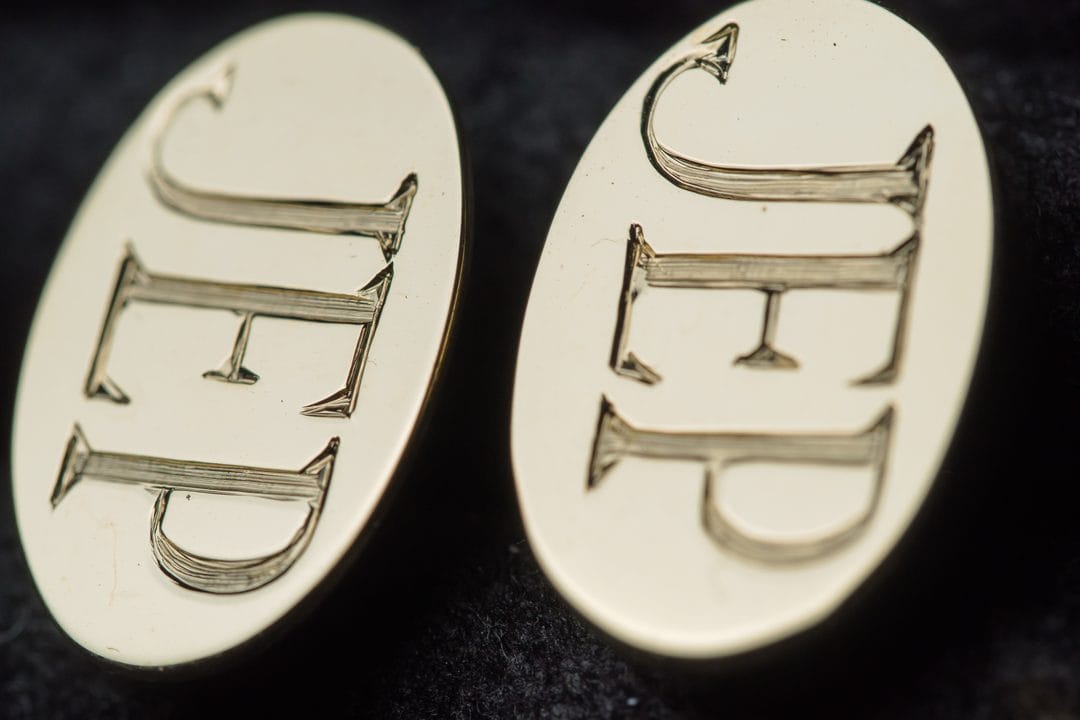
Cufflinks are the hardest sell in this whole category, mostly because fewer men wear French cuffs regularly than at any point in the past century, and a piece that only works with one specific shirt style is a harder purchase to justify than a ring or bracelet worn every day. Deakin & Francis makes the case anyway, and has been making it since 1786, when the Birmingham workshop that still produces every pair today first opened in what is now the city's historic jewelry quarter. The firm is run by seventh-generation brothers James and Henry Deakin, uses Single Mine Origin gold traceable to its source, and is best known for mechanical cufflink designs — pieces with moving parts, like a skull whose jaw opens to reveal diamond eyes, that have nothing to do with the plain knot-and-bar cufflinks sold in department store gift sets. Over two centuries the workshop has produced more than 2,000 distinct cufflink designs, stocked today at Harrods among other retailers, and every pair is still hand-finished in the same Birmingham factory rather than outsourced to the contract manufacturers that make most cufflinks sold under bigger names. For anyone who does wear cuffs regularly — bankers, lawyers, anyone in a genuinely formal office — this is the brand worth the wait over a generic pair from a fashion house that also makes handbags and cologne.
Miansai and the Honest Entry Point
Not every piece in this category needs to cost four figures, and Miansai is the clearest example of doing the accessible end properly instead of cutting corners on it. Michael Saiger started the brand in 2008 with a single rope-and-hook bracelet made from the same nylon cord the US Coast Guard uses, and the anchor clasp — rounder at the bottom than most competitors' versions, recognizable before you even spot the engraved logo — is still hand-assembled by a small team of roughly thirty people rather than mass-produced overseas. The metal hardware comes in genuine .925 sterling silver, 14 karat yellow gold, and 14 karat rose gold rather than base-metal plate, which is the detail that separates it from the beach-stall version of the same idea sold at every resort gift shop. It is not trying to compete with Cartier or Foundrae, and it does not need to — it is the bracelet you actually wear surfing or at the gym while the gold pieces sit in a drawer, and having something in that role means the expensive pieces last longer because they are not absorbing daily wear they were never built for.
What to Actually Buy First in 2026
Start with one piece, not three. A signet ring earns its place before a chain bracelet does, because it does something a watch cannot — it sits on the hand doing nothing but existing as a small, permanent object, the way a wedding band does, and that is a different kind of ownership than anything with a dial and a movement. Skip the plated costume pieces sold at watch-collector price points online; if the listing does not mention a hallmark, a karat number next to a trademark, or a specific gold thickness for vermeil, walk away regardless of how convincing the photos look. Buy the Love bracelet if recognition matters to you and you are comfortable with everyone who sees it knowing roughly what it cost. Buy Foundrae if you would rather the meaning stay private. And if you are not ready to spend real money yet, a Miansai bracelet in solid 14 karat gold hardware is a genuinely honest way to find out whether this category is for you before committing to something that needs a proper hallmark and a story to go with it.