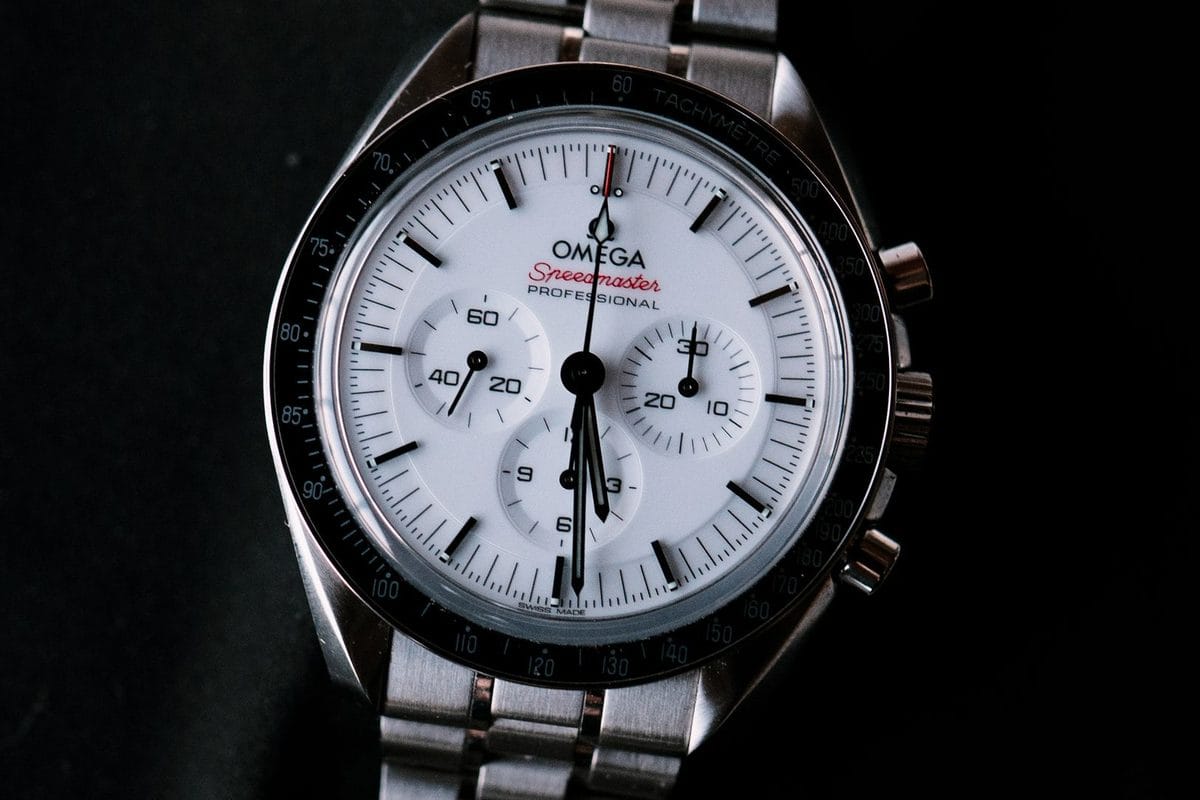
Buzz Aldrin stepped onto the lunar surface on 20 July 1969 wearing an Omega Speedmaster Professional on his wrist. Neil Armstrong left his own Speedmaster inside the lunar module as a backup timer for the cabin clock, which still surprises most people who assume the more famous watch belongs to the more famous name. That detail says something about the Speedmaster that hasn't changed in fifty-seven years: it was built to be a working tool first, and it became a status symbol almost by accident.
That accident now shapes an entire buying decision for men getting serious about watches for the first time. A steel Rolex Daytona still commands a waiting list at most authorised dealers, and the emotional pull of the crown logo is real. But the Speedmaster gives you flight-tested history, a manufacture movement with genuine engineering behind it, and a purchase you can actually complete this month rather than sometime next year.
A watch that earned its reputation the hard way
NASA didn't choose the Speedmaster because Omega asked nicely. In 1964, the agency quietly bought several chronographs from local shops in Houston, stripped the branding, and ran them through a punishing qualification programme: 93°C heat cycling alongside minus 18°C cold, near-total vacuum, 40G shock tests, and sustained vibration that would shake a lesser movement apart. Engineer James Ragan led the testing, and in March 1965 the Omega Speedmaster came out the only survivor, officially qualified for all manned space missions. Four years later it was on the Moon, and four years after that it did something arguably more impressive.
During Apollo 13 in April 1970, an oxygen tank explosion knocked out the command module's primary systems, and the crew had to fly a manual re-entry burn with no working clock they could fully trust. Jack Swigert used his Speedmaster's chronograph to time the 14-second engine burn that corrected their trajectory home, because a few seconds either way meant missing Earth's atmosphere entirely or burning up in it. That's not marketing copy. That's a chronograph doing exactly the job it was designed for, under the worst conditions anyone has ever tested a wristwatch in.
The 2026 line-up, and where the money actually goes
The core Speedmaster Professional Moonwatch, reference 310.30.42.50.01.001 with its domed hesalite crystal, still anchors the range and typically lists for around £6,900 to £7,300 at UK authorised dealers depending on bracelet or strap configuration. Step up to the sapphire-crystal version with the see-through caseback and you're closer to £7,800. Both run the calibre 3861, and both are genuinely the same watch Aldrin wore in spirit, if not in every internal detail.
Above that sits a set of variations aimed at collectors who already own the standard Moonwatch and want something with more personality. The Dark Side of the Moon, cased entirely in black zirconium oxide ceramic, runs roughly £9,600. The Moonshine Gold edition uses an 18-karat gold alloy Omega developed in-house specifically to resist the fading that standard yellow gold suffers under UV light, and it starts near £34,000 on the tape bracelet. Then there's the Speedmaster Professional Calibre 321, Omega's hand-wound reissue of the original 1960s movement complete with a period-correct straight-lug case — production is deliberately small, and steel examples start north of £13,000, sometimes considerably more once you factor in how hard they are to actually find in stock.
The entry point that doesn't need a waiting list
You can walk into an Omega boutique on a Tuesday afternoon and walk out wearing a Speedmaster Professional.
Compare that to the steel Rolex Daytona, reference 126500LN, where authorised dealers routinely quote informal waits of twelve to twenty-four months, contingent on purchase history and, unofficially, on how much else you've bought from that particular boutique. If you want a serious chronograph now rather than in eighteen months on a relationship-building waiting list, the Speedmaster is the better choice, full stop. There's no purchase-history game to play, no need to buy three other watches first to prove you're a genuinely serious client.
Why availability changes who actually buys one
This matters more than it sounds like it should. A watch you can buy on demand is a watch you buy because you want it for yourself, not because you finally cleared a waiting list and feel obligated to take whatever configuration the dealer offers that day. Ask any AD sales associate off the record and they'll tell you the Speedmaster buyers are, on average, more engaged with the actual watch — the history, the movement, the strap options — than buyers working through a Rolex allocation queue.
Value retention: the boring truth about resale
Here's the part collectors don't like admitting out loud. The steel Daytona's grey-market premium, which sat well above £15,000 over retail through much of 2022 and 2023, has compressed noticeably through 2024 and 2025 as Rolex increased production and dealer allocations loosened slightly — some London dealers now quote closer to £4,000 to £6,000 over the roughly £14,200 UK retail price, a fraction of where it stood two years ago. The Speedmaster Professional Moonwatch, by contrast, has held near retail for most of the last decade, occasionally dipping slightly below on the pre-owned market when a seller needs cash quickly.
That's not true of every reference, though, and this is where the nuance actually lives. The Calibre 321 reissue routinely trades above its already-high retail price on the pre-owned market, because Omega deliberately limits production and demand from serious collectors consistently outstrips supply. So the honest picture isn't that Speedmasters hold value and Daytonas don't — it's that scarcity drives premiums regardless of brand, and the standard Moonwatch simply isn't scarce enough to inflate, which is exactly why it's the more rational first purchase.
Buy the Speedmaster Professional Moonwatch as the watch you'll actually wear, not as the watch you're hoping to flip in three years. That's the honest way to approach it, and the resale numbers back that approach up anyway — you're not paying a speculative premium you might not get back, and you're not losing sleep over whether the market cools before you've worn it twenty times.
What's actually inside — the manufacture case
Omega's Co-Axial escapement, originally invented by British watchmaker George Daniels and adopted across the range since 1999, reduces friction between the escapement's moving parts compared with the traditional Swiss lever escapement most other brands still use. Less friction means less need for lubrication at that specific point, and less lubrication breakdown means the movement holds its accuracy for longer between services.
Since 2015, every Speedmaster Professional has carried Master Chronometer certification from METAS, the Swiss Federal Institute of Metrology — an independent testing standard on top of standard COSC chronometer certification. That means each watch is tested fully cased, not just as a bare movement, and must withstand magnetic fields up to 15,000 gauss without losing accuracy, roughly the field strength you'd encounter near an MRI machine. The current calibre 3861 also uses a silicon balance spring, which is immune to magnetism entirely and doesn't require the periodic demagnetising that older Speedmasters occasionally needed after sitting near a laptop speaker or a phone case with a magnetic clasp.
Buying advice for a first Speedmaster
A few decisions actually matter here, and most first-time buyers get them backwards.
- Hesalite versus sapphire: hesalite is the historically correct choice and scratches easily but polishes out with toothpaste and a soft cloth in about two minutes; sapphire resists scratching almost entirely but will crack rather than scuff if you hit it hard against something.
- Buy from an authorised dealer where possible, since Omega's warranty and service network is significantly less fussy about provenance than Rolex's, and a full box-and-papers set genuinely does add three to five per cent to resale value down the line.
- The stainless steel bracelet suits daily wear far better than the leather NASA strap, which looks the part for photos but doesn't hold up to a British summer the way steel does.
- Grey-market dealers in London — Watches of Switzerland's pre-owned arm, and reputable independents around Hatton Garden — can sometimes beat boutique pricing on lightly worn examples, so it's worth checking both before committing.
Get the service interval into your calendar the day you buy it. Omega recommends a full service roughly every eight to ten years for the calibre 3861, and skipping that isn't a cosmetic issue — it's how you end up with a gummed-up chronograph mechanism that costs more to fix than the service would have.
The watch that doesn't need the story told to you
Most luxury purchases need someone to explain why they're worth the money. The Speedmaster is the rare one where you already know — it went to the Moon, it saved three astronauts on the way back from a mission that nearly killed them, and fifty-seven years later you can still buy the same watch, running the same basic design, from the same company that built the original. Put it on, set the bezel, and it does exactly what it did in 1969.