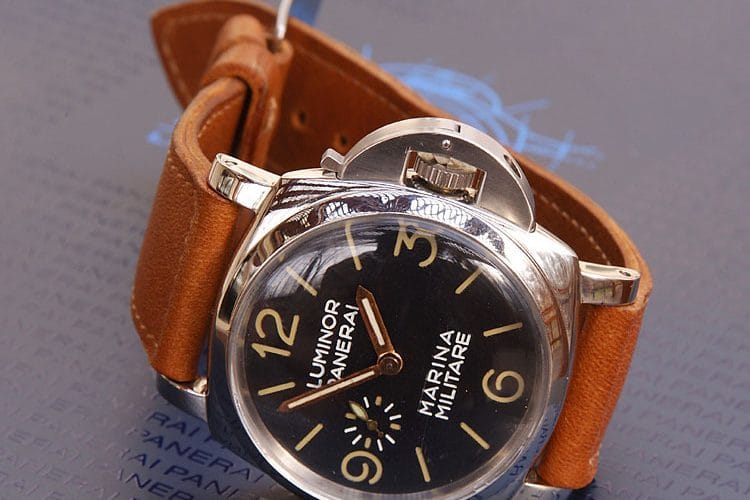
In 1938, a handful of Italian Royal Navy divers strapped waterproof watches to their wrists before slipping into the black water off La Spezia, training with underwater breathing apparatus that would later be used against British warships in Gibraltar and Alexandria. The watch on their wrist came from a small workshop in Florence, Guido Panerai & Figlio, which had been supplying the Italian Navy with precision instruments since 1860. Its dial used a radium-based luminous compound bright enough to read at depth in total darkness — the reason the model was named Radiomir. For more than half a century that watch never appeared in a shop window, a display case, or an advertisement, because it wasn't for sale. Officine Panerai now sells a close relative of the same case in boutiques from Milan to Manchester, and understanding how a classified military tool became a five-figure retail watch tells you more about where the brand sits in 2026 than any spec sheet.
From Navy Contractor to Boutique Brand
Panerai stayed a defence supplier, not a watchmaker with a public catalogue, until 1993. The company had spent the 1930s and 1940s developing depth gauges, underwater compasses, and dive lights for the Decima Flottiglia MAS, the Italian Navy's frogman unit, and the watches it built were part of that same military contract rather than a commercial product line. When Panerai finally began selling watches to civilians, it did so by reissuing pieces almost identical to the wartime originals — the same cushion case, the same wire lugs, the same oversized dial designed to be legible through a diving mask. Sylvester Stallone found the brand on a trip to Rome in the mid-1990s, had a batch of watches customised for himself and his film crew, and wore one prominently enough that demand outpaced what the small Florentine workshop could produce. Richemont bought Panerai in 1997, which is the point where the brand stopped being an open secret among Italian collectors and became a proper watch company with boutiques, a dedicated manufacture in Neuchâtel, and a fan base — the Paneristi — organised enough to run its own conventions. That transition from classified naval supplier to Richemont-owned luxury house happened inside fifteen years, which is fast even by watch-industry standards, and it left the brand with a heritage story most competitors would need a century to build honestly.
Radiomir or Luminor — the Case Is the Whole Argument
Two case families define the modern Panerai catalogue, and the difference between them is not cosmetic. The Radiomir keeps the original 1930s design: a cushion-shaped case with wire lugs soldered directly to the body, no crown guard, and a slimmer profile that reads closer to a vintage instrument than a tool watch. The Luminor, patented in 1949 under Italian patent number 247942, added the feature everyone now associates with the brand — a hinged bridge and locking lever over the crown, originally meant to keep seawater out during long dives and now functioning mostly as the brand's visual signature. Buy a Radiomir and you're buying the quieter, more historically literal watch; buy a Luminor and you're buying the one people actually recognise on the wrist, lever and all. Both lines run large by any mainstream standard — 42mm is the floor, 44mm is the default, and Panerai still sells 47mm pieces for buyers who want the closest thing to the original wartime proportions. That size is also where Panerai loses people: a 44mm Luminor sits noticeably higher off the wrist than an Omega Seamaster of the same diameter, and on a wrist under 17cm it can look like exactly what it is — a piece of Italian Navy dive equipment wearing a suit.
The Submersible Question
Three days. That's the power reserve Panerai prints on almost every current spec sheet, and it's the one number worth remembering when everything else about this brand feels like theatre.
Panerai spun the Submersible out of the Luminor family as its own collection at SIHH in 2019, and the split made sense the moment you compare the two side by side. Where the Luminor Marina is a watch shaped like a dive tool, the Submersible is an actual dive watch — a unidirectional rotating bezel, 300 metres of water resistance on the steel models, and a case built specifically around that function rather than around 1930s aesthetics. Both lines now run on Panerai's in-house automatic movements, most commonly the P.9010, which is worth paying attention to if you've shopped other watches in this price range: a lot of brands between roughly £6,000 and £8,500 are still running outsourced ETA or Sellita movements with a house-branded rotor stamped on top, and Panerai isn't one of them. A steel Luminor Marina 44mm typically starts around £6,900 at retail; step up to the Submersible 44mm and you're closer to £8,500, mostly for the bezel, the extra water resistance, and — depending how cynical you want to be about it — the name that currently has more momentum among dive-watch buyers under 40.
The Sandwich Dial Is the Detail Worth Knowing
Open the case back on an early Radiomir and you'll find a construction trick that still defines the brand: the sandwich dial. Panerai builds the dial in two layers, cutting the numerals and markers out of the top plate and filling the cavity underneath with luminous compound, so light shines up through the numeral shape itself rather than sitting on top of it as printed paint. It's a manufacturing decision from the 1930s, born out of a need for maximum legibility at depth rather than any interest in aesthetics, and it's the reason a Panerai dial still looks different from almost anything else in a display case — the numerals appear to glow from inside the dial rather than off its surface. The anchor logo above the six o'clock marker on Radiomir models is the other detail worth knowing, a direct reference to the Marina Militare contract rather than a decorative flourish, and it's absent from the Luminor line for the simple reason that the Luminor was developed after Panerai's most formal Navy supply period had already ended. None of this changes how the watch keeps time. It changes how convincing the whole story feels once you know what you're looking at, and on a brand that sells heritage as hard as Panerai does, that's not a small thing.
Where Panerai Actually Fits in a 2026 Collection
If you already own a Rolex Submariner or a Tudor Black Bay, the honest question isn't whether Panerai is a good watch — it clearly is — but whether it does anything the watch already on your wrist doesn't. The answer is yes, and it comes down to presence rather than performance. A Panerai reads differently in a room than a Rolex does: less about resale value and status signalling, more about the fact that almost nobody else at the table owns one. That's precisely why it works as a third or fourth watch and works badly as a first one — buy your first serious mechanical watch from a brand people can identify at a glance, then buy a Panerai once you're collecting for yourself rather than for anyone else's approval. Skip the Radiomir until you already own a Luminor; the smaller, quieter case reads as more interesting once you understand what it's a reaction against, and buying it first means missing the reference point entirely. Buy steel over the titanium or ceramic options at this stage, too — the ceramic Luminor is a genuinely striking watch, but it adds £3,000–£4,500 to the price for a material advantage that matters far more to a working diver than to someone wearing it to dinner in Marylebone.
A few things worth checking before you sign anything at the boutique:
- Whether the model runs the in-house P.9010 or an older, smaller P.5000 hand-wound calibre — the two feel completely different on the wrist despite sitting in near-identical cases
- Strap system — Panerai's quick-release lugs make swapping between rubber, leather, and steel bracelet genuinely easy, which matters more day-to-day than most reviews admit
- Case size against your own wrist, tried on in person, because a 44mm Panerai wears larger than a 44mm Omega or Tudor
- And whether the dealer is actually an authorised Panerai boutique, since the grey market for this brand is smaller and less policed than Rolex's
Buying New or Preowned
Panerai's resale market tells its own story, and it's a less flattering one than Rolex's. A steel Luminor Marina bought new for around £6,900 commonly resells in the £4,700–£5,400 range within a couple of years on the preowned market, a steeper drop than you'd see on a comparable Omega or Tudor. For a buyer chasing investment value that's a real problem; for a buyer who actually wants to wear the watch, it's an opportunity most people overlook. Shopping preowned means the same in-house P.9010 movement, the same case, and the same lever-locked crown for 20–25% less than a boutique charges — and because Panerai's demand curve runs younger and less status-driven than Rolex's, the preowned market isn't nearly as picked-over. Chrono24 and the specialist dealers who focus on Richemont-group brands are the two starting points worth checking before any boutique visit, and it's worth handling two or three examples in person before deciding between the Marina and the Submersible — photographs flatten a size difference that's obvious the moment either watch is actually on your wrist.
The lever over the crown is still functional, even on a Luminor Marina you'll never take diving — flip it open and the crown turns as smoothly as it did on the frogman prototypes from 1938, which is either a nice piece of engineering continuity or a completely pointless one, depending on how seriously you take the Navy story Panerai is still selling you.