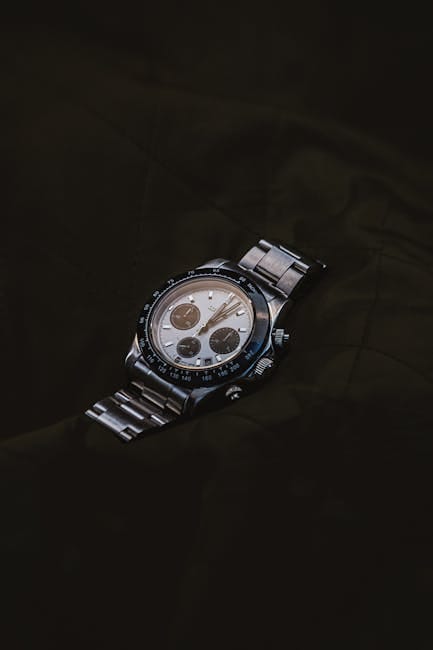
Sunday evening, mid-April 2026, watch collector chat rooms are quieter than they were two years ago. The Twitter hot takes about Rolex waitlists have largely stopped. The YouTube channels that spent 2022 documenting Nautilus flip profits have pivoted to other content. Phillips auction hammer prices from the past six months confirm what WatchCharts data has shown since 2024: the luxury watch bubble that peaked in March 2022 is genuinely over, the correction has been severe for some references and mild for others, and the market that has emerged on the other side looks substantially different from the pre-bubble baseline.
Understanding where prices actually landed requires distinguishing between three different market segments that behaved very differently through the bubble cycle. The modern luxury sports watch segment corrected dramatically. The dress complication segment barely moved. The independent watchmaker segment continued appreciating even as the broader market fell. Each of these tells a different story about what the 2026 market actually values.
The Modern Sports Watch Correction
Rolex Submariner 124060 (no-date Submariner, steel): Peak secondary market price in Q1 2022 was approximately $17,500 against a $9,100 retail. Current April 2026 secondary market is $11,200-$12,500 for clean examples with papers. Correction is roughly 33% from peak, now trading at 22% premium to retail rather than the 92% premium at peak.
Rolex GMT-Master II Pepsi 126710BLRO: Peak secondary in Q1 2022 was $26,000 against $10,900 retail. Current April 2026 is $15,800-$17,200. Correction 38% from peak, premium to retail reduced from 140% to 50%.
Patek Philippe Nautilus 5711/1A (discontinued after 2021): Peak secondary in Q2 2022 was $240,000. Current April 2026 is $135,000-$155,000. Correction 42% from peak but still trading at roughly 4x the original $35,000 retail price.
Audemars Piguet Royal Oak 15400ST (40mm discontinued): Peak secondary Q1 2022 was $68,000. Current April 2026 is $42,000-$48,000. Correction 34%.
The pattern is consistent across the modern sports watch category. Peak prices reflected a speculative bubble that has deflated meaningfully. Current prices still carry significant premium to retail, but the premium has normalized to levels that reflect genuine demand rather than hype-cycle speculation.
Why the Correction Happened
Three factors converged in 2022-2023 that ended the bubble.
First, macroeconomic conditions shifted. Crypto market collapse in 2022 eliminated a specific buyer segment that had been paying premium prices across luxury asset classes. Tech sector layoffs in 2023 reduced discretionary income for another key demographic. Interest rate increases made the opportunity cost of money tied up in watches materially higher.
Second, supply increased. Rolex and Patek both quietly expanded production capacity through 2022-2024. Audemars Piguet similarly increased output. More watches reaching the market at retail reduced the scarcity that had driven secondary market premiums.
Third, collector attention shifted. The specific references that drove 2021-2022 speculation (Nautilus 5711, Rolex steel sports, Royal Oak steel) became oversaturated in social media and collector conversations. New collector interest migrated toward independent makers and historic references, leaving the modern sports category without the marginal demand that had sustained peak prices.
The Dress Complication Stability
Patek Philippe Calatrava 5227G (white gold with officer's case): Peak secondary Q1 2022 was $42,000 against $39,000 retail. Current April 2026 is $38,000-$41,000. Essentially flat through the entire cycle, with mild softening of 8% from peak.
A. Lange & Söhne Saxonia Thin reference 211.025 (white gold): Peak secondary Q2 2022 was $28,500 against $26,500 retail. Current April 2026 is $26,800-$28,000. Flat pricing, no meaningful correction.
Vacheron Constantin Patrimony 85180/000R (rose gold): Peak secondary Q2 2022 was $31,000 against $28,500 retail. Current April 2026 is $28,200-$30,400. Mild softening of 6% from peak.
The dress complication segment barely moved through the 2022-2024 correction. Prices stayed within 5-10% of retail through the entire cycle, with the premium representing authorized dealer allocation preference rather than speculative demand.
Why Dress Complications Held
Two reasons, and the combination matters.
First, dress watch buyers are different from sports watch speculators. The typical Calatrava or Saxonia buyer is purchasing for personal wear rather than flip potential. This buyer cohort is more stable through market cycles because their purchase motivation isn't tied to secondary market appreciation.
Second, dress watch production is more predictable and supply-matched to demand. Patek produces a steady volume of Calatrava references annually. Demand for dress watches grows slowly rather than spiking with social media trends. The supply-demand balance remained functional through the bubble cycle, unlike sports watches where speculation created artificial demand that supply couldn't match.
The Independent Watchmaker Appreciation
Akrivia Chronomètre Contemporain II: 2022 secondary market price roughly $180,000 against $62,000 retail. Current April 2026 secondary is $260,000-$290,000. Continued appreciation of roughly 50% during the period when modern sports watches were correcting 30-40%.
F.P. Journe Chronomètre Bleu: 2022 secondary market was approximately $95,000 against $48,000 retail. Current April 2026 secondary is $140,000-$165,000. Appreciation of 55% during the correction.
Philippe Dufour Simplicity: 2022 secondary market was $450,000. Current April 2026 is $620,000-$780,000. Continued appreciation of 45%+.
De Bethune DB25 Starry Varius titanium: 2022 secondary market was $70,000 against $72,000 retail. Current April 2026 is $72,000-$82,000. Modest appreciation through the correction period.
The independent watchmaker segment continued appreciating across the same three years that modern sports watches corrected. This inversion is one of the more significant structural shifts in the current collector market.
What Drives Independent Appreciation
Three factors specific to the independent segment.
First, production genuinely cannot scale. Akrivia makes 35 watches per year. F.P. Journe makes roughly 900 watches per year across all references. Philippe Dufour produces perhaps 3 Simplicity watches annually when he's producing at all. These production constraints are physical rather than marketing — the workshops literally cannot produce more watches without compromising what makes the brand distinctive.
Second, the collector segment that buys independents has become increasingly sophisticated. A buyer who commits $280,000 to an Akrivia Contemporain II has typically already owned multiple luxury sports watches and has developed a specific appreciation for hand-finishing and mechanical content. This buyer segment is less sensitive to broader market conditions and continues purchasing through corrections.
Third, scarcity compounds over time. Each year that passes without production increases reduces the relative availability of any given independent reference. An Akrivia from 2020 becomes rarer every year as the total population of 2020-produced examples stabilizes and demand continues growing. This compounding scarcity drives continued appreciation even without speculative market conditions.
The Segments That Still Aren't Clear
Some specific references and segments remain ambiguous in April 2026.
Rolex Daytona steel: The 126500LN Daytona launched in 2023 with revised case proportions and the calibre 4131 movement. Secondary market pricing has been volatile — initial demand pushed prices to $48,000 at launch peak, softened to $35,000 by late 2024, and has rebounded to $38,000-$42,000 through 2025-2026.
Richard Mille watches broadly: Classic sports references like the RM011 have corrected significantly (50%+ from 2022 peaks). Limited edition pieces tied to celebrity endorsements have held or appreciated. The overall Richard Mille market is difficult to characterize.
Vintage Rolex references: The vintage collector segment (1950s-1970s Rolex sports watches) has been quietly appreciating through the modern sports correction. Paul Newman Daytona references have set new auction records throughout 2024-2025.
Retail Market Changes
Authorized dealer availability has improved dramatically for most references. In 2022, walking into a Rolex authorized dealer and buying a steel sports watch at retail was essentially impossible. In April 2026, most authorized dealers have rotating availability on Submariner, GMT-Master II, and Datejust references. Allocation is still prioritized for established clients, but the multi-year waitlist structure has largely dissolved.
Patek Philippe retail access has similarly normalized. The Nautilus references remain allocation-controlled, but the broader Patek catalog (Calatrava, Aquanaut, Complications) is generally accessible to buyers with established relationships. The Aquanaut 5167/1A is actually available at multiple authorized dealers in April 2026 — a situation that would have been unthinkable in 2022.
Audemars Piguet retail distribution has restructured significantly. The brand has reduced its authorized dealer network and shifted toward direct boutique sales. Allocation prioritization at AP boutiques is strict, but for buyers who meet the brand's criteria, Royal Oak and Code 11.59 references are accessible at retail.
Authorized Dealer Economics
The retail landscape has consequences for authorized dealers that are still working through. During 2021-2022, dealers profited substantially from allocation relationships — the ability to sell scarce references created client loyalty and referral value. In the current market, references are increasingly available, which reduces dealer leverage and requires different retention strategies.
Several multi-brand authorized dealers have reduced staff or consolidated locations through 2024-2025. The jewelry-plus-watch retail model that dominated the 2010s-2020s is under pressure. Single-brand boutiques owned or tightly controlled by the manufacturer have increased their share of overall luxury watch retail.
Forecasting the Next 18 Months
Modern sports watch correction will probably continue, but at a slower rate. Further declines of 10-15% over the next 18 months are plausible but unlikely to be as severe as the 2022-2024 correction phase.
Independent watchmaker appreciation will continue for specific references. Akrivia, F.P. Journe, Philippe Dufour, Voutilainen, Roger Smith, and a few others have supply-demand fundamentals that support continued appreciation.
Dress complication segment will remain stable. Patek Calatrava, Lange Saxonia, and Vacheron Patrimony references will probably continue trading within 5-10% of retail through 2027.
What This Means for Buyers
If you wanted a Rolex Submariner at retail and couldn't get one in 2022, you probably can get one in 2026. The waitlist has dissolved for most steel sports references. Walk into a dealer, establish a relationship, purchase at retail within 6-12 months.
If you're considering a Nautilus or Aquanaut at current secondary market pricing, the market has already absorbed most of the correction. Prices might decline another 5-10% but the pre-2020 pricing levels ($35,000 retail for a 5711) aren't returning. Current $135,000 pricing is the likely floor for the reference.
If you're considering an independent watchmaker piece, secondary market is the practical path for most references. Retail allocations are tighter than ever at the established independents. Prices will probably continue appreciating, but the rate of appreciation will vary significantly by specific reference and maker.
If you're a dress watch buyer, the market is essentially unchanged from pre-bubble conditions. Patek Calatrava, Lange Saxonia, Vacheron Patrimony references are available at retail with normal delivery timelines and pricing that has moved only slightly through the cycle.
The Broader Context
The 2021-2022 bubble was not a normal condition of the luxury watch market. The pre-bubble baseline (roughly 2015-2019) represented more typical pricing. The current 2026 market is converging back toward that historical baseline, with independents trading above historical norms and sports watches still slightly above but approaching pre-bubble pricing.
Collectors who entered the market during the bubble and paid peak prices are now holding watches worth substantially less than purchase price. This experience has been educational for a generation of buyers who assumed luxury watches were reliable appreciating assets.
For now, the market is calmer than it's been in five years. Waitlists are shorter. Secondary market pricing is more rational. Collector conversations have shifted from flip economics to actual watches. Whether this represents durable structural change or just a trough between speculative cycles will only become clear in retrospect, probably by 2028.
Buy watches for wearing. Let the market do what markets do. Check back in 2028 to see what was ultimately durable.